AI必知必会:Function Calling

从ChatGPT的横空出世,到OpenClaw的一夜爆火,AI技术的发展可谓日新月异。如果说LLM是最强大脑,那么赋予它手和脚,使其从对话框中走出来的,正是Function Calling。

Function Calling(函数调用)有时也称为Tool Use(工具使用)。按照OpenAI的官方定义,Function Calling为LLM提供了一种强大且灵活的方式,使其能够与外部系统交互并获取训练数据之外的信息

要理解Function Calling的真正价值,我们需要先来了解其背后的应用场景。

应用场景

现实生活中,我们常常需要与各种系统和服务进行交互,以获取所需的信息或完成特定的任务。例如,查询天气、预订机票、支付账单、控制智能家居设备等。

以天气查询为例:

What is the weather like in Chengdu?

为了处理这个任务,AI系统通常需要执行以下操作:

  1. 理解用户的自然语言输入,并将其转化为结构化的指令或意图(这里的意图是“查询天气”,参数是“成都”)。
  2. 根据指令调用相应的API或服务,得到结果(这里的结果可能包括温度、湿度等)。
  3. 将结果加以整理和格式化,再以自然语言的形式返回给用户(例如,“今天成都的气温是22度,湿度为60%”)。

由此可见,这类AI系统的本质在于:

自然语言 → 结构化语义 → 触发系统动作

其中,从自然语言到结构化语义的转换,是整个流程的核心。

NLU

在LLM出现之前,这类任务通常由传统的自然语言理解(Natural Language Understanding, NLU)来完成。作为NLP的一个子集,NLU技术主要包括意图识别(Intent Recognition)和槽位填充(Slot Filling)两个子任务。

上述天气查询的例子,经过NLU处理后,得到的结构化输出大致是这样的:

query What is the weather like in Chengdu ?
slots O O O O O O B-loc O
intent get_weather

然而,NLU技术存在一些明显的局限性:

  • 所有意图必须预定义(分类)
  • 所有槽位必须事先建模(序列标注)
  • 泛化能力差,新场景需要重新训练模型
  • 多步推理能力几乎为0

Prompt Engineering

LLM兴起以后,其强大的生成式语义推理、结构约束和泛化能力,完美地解决了NLU的诸多痛点。然而,早期的LLM并不具备Function Calling的能力(如DeepSeek-R1)。于是,人们主要通过Prompt Engineering(提示词工程)的方式,引导LLM生成符合预期的结构化数据。

例如,针对天气查询的例子,可以设计如下Prompt:

You are an assistant that can perform actions based on user requests. Your responses should be in JSON format with the following structure:

1
2
3
4
5
6
7
{
"name": "action_name",
"arguments": {
"key1": "value1",
"key2": "value2"
}
}

Query: What is the weather like in Chengdu?

发给LLM后,就能得到如下JSON格式的文本输出:

1
2
3
4
5
6
{
"name": "get_weather",
"arguments": {
"location": "Chengdu"
}
}

Structured Output

上述方式虽然有效,但是稳定性不高。随着模型能力的演进,很多LLM开始原生地支持JSON mode,后来又进一步支持了Structured Output(结构化输出),生成结构化数据的能力得到了显著提升。

使用Structured Output,可以非常稳定地生成结构化数据。有些SDK(如OpenAI Python SDK),甚至还提供了与数据验证库(如Pydantic)的无缝集成,进一步增强了类型检查和数据验证的功能。例如:

1
2
3
4
5
6
7
8
9
10
11
12
13
14
15
16
17
18
19
20
21
22
23
24
25
26
27
28
29
30
31
from openai import OpenAI
from pydantic import BaseModel, Field

client = OpenAI()

class Arguments(BaseModel):
location: str

class Query(BaseModel):
name: str = Field(..., description="Action to perform")
arguments: Arguments = Field(..., description="Arguments for the action")

response = client.responses.parse(
model="gpt-4o-2024-08-06",
input=[
{
"role": "system",
"content": "Extract the query information.",
},
{
"role": "user",
"content": "What is the weather like in Chengdu?",
},
],
text_format=Query,
)

print(response.output_parsed)

# Output:
# name='getWeather' arguments=Arguments(location='Chengdu')

Structured Output vs Function Calling

事实上,在OpenAI的生态中,Function Calling(于2023年6月推出)先于Structured Output(于2024年8月推出)出现。

早期的Function Calling有时会“幻觉”出不符合格式的JSON,而Structured Output则可以确保输出严格遵循Schema。因此,Structured Output也可以看作是Function Calling能力的底层升级(Strict mode)。

从形式上来看,虽然Structured Output和Function Calling都会让LLM生成结构化的数据(通常是JSON),但它们解决的问题维度并不相同:

Structured Output Function Calling
主要目的 严格保证每一条输出都符合格式 由LLM灵活决定是否调用工具、调用哪个工具
适用场景 数据提取、实体识别、表单生成等 智能体(Agent)、检索增强(RAG)等

Function Calling

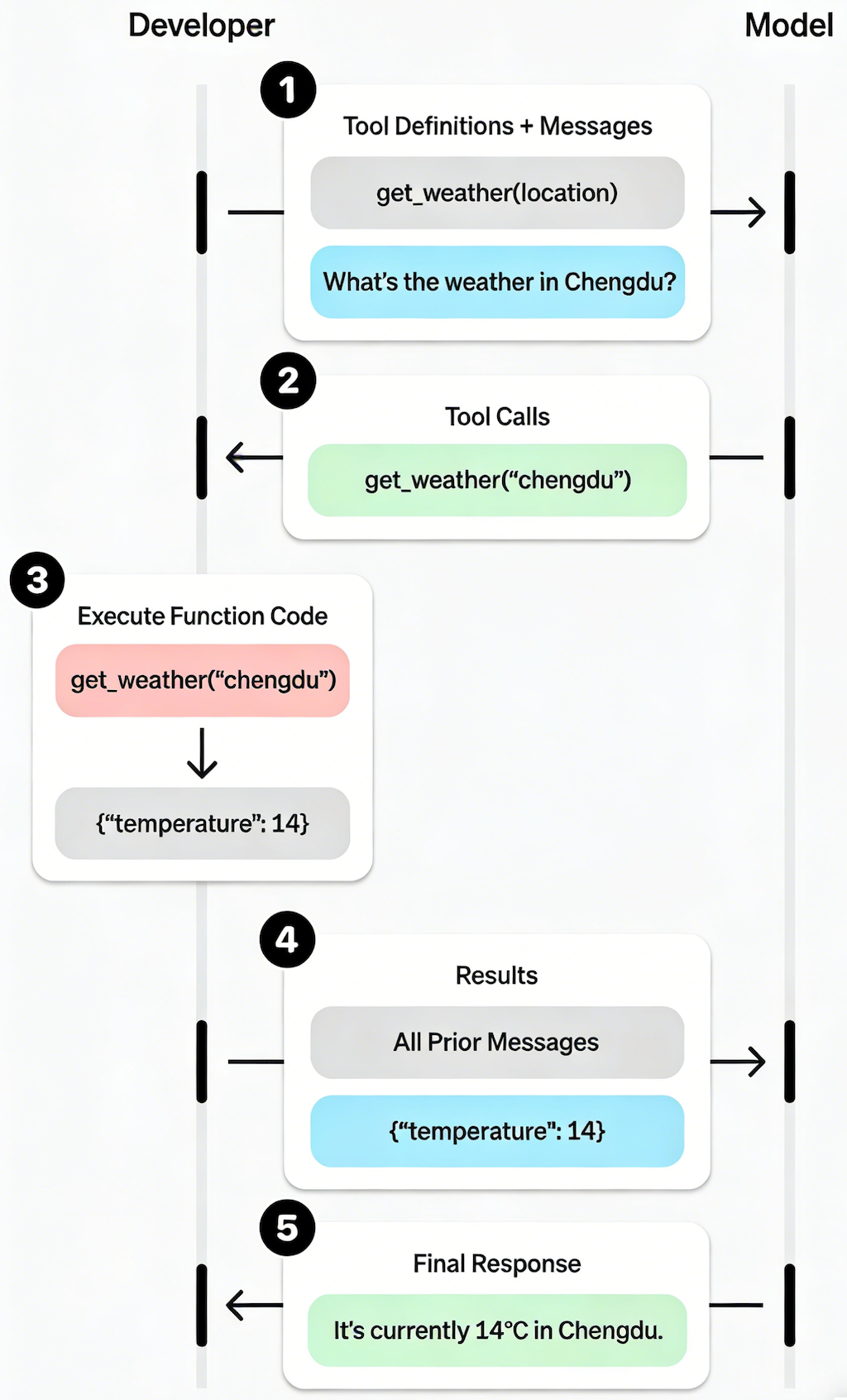
由上述分析可见,Function Calling的核心在于由LLM灵活决定是否调用工具、调用哪个工具。仍然以天气查询为例,如果我们将思维模式从“结构化输出”转变为“工具调用”,整体的解题路径就会截然不同。

Function Calling

如图所示,使用Function Calling来处理天气查询,整体的流程大致如下:

  1. 向模型发送用户请求,并明确声明其可调用的工具列表(如get_weather(location))。
  2. 模型根据请求,决定需要调用的工具名称(如get_weather)及相应的参数(如{"location": "chengdu"})。
  3. 应用程序解析工具调用请求后,执行对应的代码,并获取结果(如{"temperature": 14})。
  4. 应用程序携带工具调用的结果,再次向模型发起请求。
  5. 模型据此生成最终的回复(如It's currently 14°C in Chengdu.),或者再次调用其他工具。

如果觉得文字描述比较抽象,下面是一个可运行的Python示例:

1
2
3
4
5
6
7
8
9
10
11
12
13
14
15
16
17
18
19
20
21
22
23
24
25
26
27
28
29
30
31
32
33
34
35
36
37
38
39
40
41
42
43
44
45
46
47
48
49
50
51
52
53
54
55
56
57
58
59
60
61
62
63
64
65
66
67
68
69
70
71
72
import json
from openai import OpenAI

client = OpenAI()

# 1. Define a list of callable tools for the model
# (Note that `parameters` are defined in JSON Schema)
tools = [
{
"type": "function",
"name": "get_weather",
"description": "Retrieves current weather for the given location.",
"parameters": {
"type": "object",
"properties": {
"location": {
"type": "string",
"description": "City e.g. Beijng, Chegndu"
}
},
"required": ["location"],
"additionalProperties": False
},
"strict": True
},
]

def get_weather(location: str) -> str:
# Here you would normally make an API call to a weather service
return '{"temperature": 14}'

# Create a running input list we will add to over time
input_list = [
{"role": "user", "content": "What is the weather like in Chengdu?"},
]

# 2. Prompt the model with tools defined
response = client.responses.create(
model="gpt-5",
tools=tools,
input=input_list,
)

# Save function call outputs for subsequent requests
input_list += response.output

for item in response.output:
if item.type == "function_call":
if item.name == "get_weather":
# 3. Execute the function logic for `get_weather`
location = json.loads(item.arguments)["location"]
output = get_weather(location)

# 4. Provide function call results to the model
input_list.append({
"type": "function_call_output",
"call_id": item.call_id,
"output": output,
})

response = client.responses.create(
model="gpt-5",
instructions="You are a helpful assistant.",
tools=tools,
input=input_list,
)

# 5. The model should be able to give a response!
print(response.output_text)

# Output:
# The current temperature in Chengdu is about 14°C.

框架封装

至此,我们已了解了Function Calling的基本原理与使用方式。但在实际应用中,若每个工具都需要手动编写JSON Schema,其开发复杂度势必大幅增加。因此,众多开发框架对此进行了封装,以提供更高层次的抽象。

例如,使用LangChain提供的@tool装饰器,便能轻松地将Python函数注册为LLM可调用的工具:

1
2
3
4
5
6
7
8
9
10
11
12
13
14
15
16
17
18
19
20
21
22
23
24
25
26
27
28
29
30
from langchain.chat_models import init_chat_model
from langchain.tools import tool

model = init_chat_model("gpt-5")

@tool
def get_weather(location: str) -> str:
"""Retrieves current weather for the given location."""
return f"It's sunny in {location}."

# 1. Bind (potentially multiple) tools to the model
model_with_tools = model.bind_tools([get_weather])

# 2. Model generates tool calls
messages = [{"role": "user", "content": "What's the weather like in Chengdu?"}]
ai_msg = model_with_tools.invoke(messages)
messages.append(ai_msg)

for tool_call in ai_msg.tool_calls:
# 3. Execute the tool with the generated arguments
tool_result = get_weather.invoke(tool_call)
# 4. Pass results back to model
messages.append(tool_result)

# 5. Model generates the final response
final_response = model_with_tools.invoke(messages)
print(final_response.text)

# Output:
# It's sunny in Chengdu right now.

如今,Agent已成为主流,上述工具执行循环(Tool Execution Loop)也演进为ReAct Agent的核心范式。为此,很多框架进一步对整个Agent模式进行了抽象,从而将Function Calling的复杂性封装在高层API之下,大幅降低了开发门槛。

例如,借助LangChain提供的create_agent函数,只需寥寥数行代码,就能构建出一个完整的天气查询Agent:

1
2
3
4
5
6
7
8
9
10
11
12
13
14
15
16
17
18
19
from langchain.agents import create_agent
from langchain.chat_models import init_chat_model
from langchain.tools import tool

model = init_chat_model("gpt-5")

@tool
def get_weather(location: str) -> str:
"""Retrieves current weather for the given location."""
return f"It's sunny in {location}."

agent = create_agent(model, tools=[get_weather])
result = agent.invoke(
{"messages": [{"role": "user", "content": "What's the weather like in Chengdu?"}]}
)
print(result["messages"][-1].content)

# Output:
# It’s sunny in Chengdu right now.

结语

本文从实际应用场景出发,梳理了从传统NLU到Prompt Engineering,再到Structured Output和Function Calling的技术演进脉络,并对比了后两者在功能定位上的差异。最后,介绍了如何通过框架封装来简化Function Calling的开发流程。

在Claude Code、OpenClaw等智能体日益盛行的当下,Function Calling作为LLM的核心能力,已成为其重要的技术基石。随着这项技术的广泛应用,工具生态的开放性与标准化也愈发关键。在此背景下,MCP(模型上下文协议)已逐渐成为行业的事实标准,我们将在后续的文章中继续探讨这一话题。